
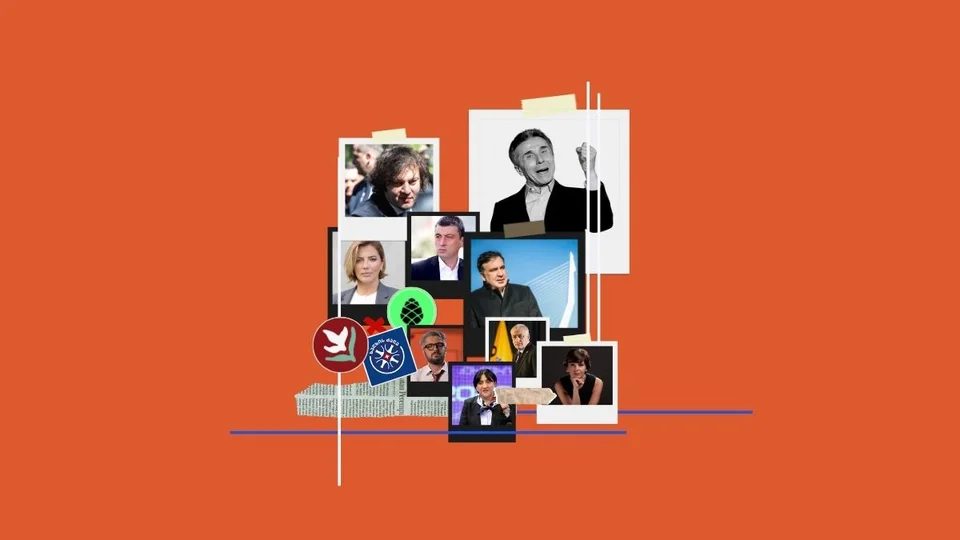
Georgia’s party system is unusually difficult to map. More than 200 parties are formally registered, although many are inactive, while new parties, movements, and electoral alliances appear frequently. Parties split, rebrand, or cooperate for a single election and then separate again. For the outside observers, the formal party list therefore says little about which actors actually matter and how they relate to one another.
Author: Sandro Tabatadze, Assistant Professor, Tbilisi State University, Georgia For much of the period after 2012, Georgian politics was organised around two poles: Georgian Dream–Democratic Georgia (GD), in power since 2012, and the United National Movement (UNM), which governed from 2004 to 2012 and then became the principal opposition force. That structure still matters, but it no longer captures the landscape as a whole. Many current parties emerged through splits from either GD or the UNM.
While some continue to gravitate back toward one of these two poles, especially ahead of elections, others are becoming increasingly alienated from them. And then, there are forces that deliberately present themselves as alternatives to both. Ideology alone is therefore a poor guide. Organisational origin, leadership networks and attitudes toward former and current ruling parties often explain behaviour better than conventional left–right labels.
Foreign-policy orientation is another major dividing line, particularly the contrast between Euro-Atlantic integration and neutrality or openly Eurosceptic positions. A third dimension has become more important since the disputed 2024 parliamentary election: institutional strategy. Most opposition parties rejected the results and refused to take up their mandates; some also boycotted the 2025 local elections, while others returned to electoral competition. Parliamentary representation alone is therefore no longer a reliable guide to political relevance.
How this guide classifies parties This guide primarily focuses on political genealogy, but uses two more criteria, including foreign-policy orientation and current institutional strategy. Genealogy and foreign-policy position provide the main structure; participation in or boycott of elections and representative institutions helps distinguish parties within the same broader camp.
While some forces and movements, including the Federalists , Girchi/Party of Free People , Girchi-More Freedom, Movement for Social Democracy , and Eurosceptic parties, maintain a strong ideological focus, such forces are yet to reach a share that would allow for an ideology-based classification of the entire political spectrum. The categories are analytical rather than formal coalition labels: actors placed in the same group do not necessarily cooperate or share identical programmes.
The guide covers 22 relatively visible political actors and divides them into five groups: The ruling and ruling-aligned camp The pro-European opposition originating from the ruling party Pro-European parties originating from the former ruling party and its splits Pro-European “third force” opposition The Eurosceptic opposition 1. The Ruling and Ruling- Aligned Camp The ruling camp is centred on Georgian Dream (GD). Founded in 2012 by billionaire Bidzina Ivanishvili, now the party’s honorary chairman, GD came to power at the head of a broad opposition coalition.
Over time, coalition government gave way to single-party rule. The party’s initial big-tent and broadly pro-Western profile has also changed substantially. GD still formally presents European integration as a national objective, but increasingly frames relations with EU institutions and Western partners through sovereignty, external interference and conspiracy narratives, including references to a “Global War Party” or “Deep State”. Prime Minister Irakli Kobakhidze currently chairs the party. Three formally separate actors are best understood as part of the wider ruling-aligned space.
People’s Power was founded in 2022 by MPs who formally left GD while continuing to support its parliamentary majority. Its members later ran again on the GD list in the 2024 parliamentary election. After the election, they once more separated from the majority and presented themselves as part of a “healthy opposition”. Sozar Subari chairs the group. The European Socialists were founded in 2021 under Fridon Injia. They had run on the conservative Alliance of Patriots (AoP) party list in the 2020 elections but entered parliament after distancing themselves from the AoP’s boycott.
The party did not contest the 2024 parliamentary election independently, but three MPs elected on the GD list later left the ruling faction and re-established a parliamentary group under the European Socialists name. The group, led by Ilia Injia, has likewise been presented as part of the “healthy opposition”. United Neutral Georgia is a newer and somewhat different case. The movement emerged in 2024 and held its founding congress as a political party in December 2025. It advocates permanent neutrality and rejects Georgia’s Euro-Atlantic integration.
Formally, it is not part of GD and at times criticises the government for remaining attached to what it calls “Euro-illusions”. In practice, however, its discourse has repeatedly echoed and amplified core GD narratives about the pro-EU opposition, Western interference and national sovereignty, while several founders have prior links to the ruling party or its political orbit. The party is led by Vato Shakarishvili.
These parties are not organisationally identical: GD governs; People’s Power and the European Socialists are parliamentary offshoots closely tied to it, while United Neutral Georgia operates outside parliament on a more radical anti-EU flank. Their inclusion in the same group reflects political alignment rather than organisational ties. 2. The Pro-European Opposition Originating from the Ruling Camp Gakharia—For Georgia (FG) is the only major active opposition party to have emerged directly from GD.
It was founded in 2021 after Giorgi Gakharia resigned as prime minister and broke with the ruling party. Before the split, Gakharia had been one of GD’s most prominent figures, serving as interior minister and then prime minister from 2019 to 2021. FG presents itself as a pro-European force and accuses GD of abandoning Georgia’s Western trajectory. It rejected the official results of the 2024 parliamentary election and initially joined the parliamentary boycott without renouncing its mandates.
The party later contested the 2025 local elections and ended the boycott, becoming the only opposition force elected in the 2024 disputed vote to enter parliament. Gakharia has remained in Germany since June 2025 amid mounting legal and political pressure and was charged in absentia in two criminal cases in November 2025. 3. Pro-European Parties Originating From Former Ruling Party and Its Splits The third and largest group centres on the United National Movement (UNM) and pro-European parties that emerged directly or indirectly from its political and organisational networks.
Within this wider political genealogy, however, the parties now occupy very different positions: some continue to cooperate closely with the UNM, while others have developed more autonomous political identities. The UNM was founded in 2001 under Mikheil Saakashvili, who became president after the 2003 Rose Revolution and is currently imprisoned in Georgia. The party governed from 2004 to 2012 and remained the principal pro-Western opposition force for much of the following decade.
Disputes over leadership, internal decision-making and electoral strategy subsequently produced several major splits . In the 2024 disputed parliamentary election, the UNM was the principal force in the Unity—National Movement coalition, but the second -best-performing opposition force per official results. Two important parties emerged directly from earlier UNM divisions but eventually re


